
Embedding Sustainability in How We Work
Embedding Sustainability in How We Work Integrating environmental responsibility into our work-culture as part of a more climate-conscious future.
Over the past decade, climate and sustainability have moved from the margins of corporate reporting into the core of business strategy worldwide. More than 9,000 companies have now set or committed to set science based emissions reduction targets under global frameworks such as the Science Based Targets initiative, and over 80 percent of large companies across advanced markets publish some form of ESG or sustainability disclosure, often referencing standards such as the GHG Protocol, ISO 14001, the Task Force on Climate related Financial Disclosures and the Global Reporting Initiative. Together, these practices signal a global shift in which measuring emissions, managing environmental impacts and reporting transparently are increasingly seen as integral elements of responsible, modern organisations rather than optional add-ons.
In Pakistan, sustainability practices are also evolving as more organisations recognise the importance of environmental stewardship and responsible growth. Many firms have begun to adopt practical measures such as improving energy efficiency in offices and facilities, installing solar and other alternative energy solutions, reducing paper use through digital workflows, introducing basic waste segregation and recycling, and promoting water conservation in day to day operations. Standards such as ISO 9001 and ISO 14001 are becoming more common, and an increasing number of companies now track elements of their environmental footprint. However, Pakistan does not yet have a unified regulatory framework, climate sensitive policy or mandatory reporting mechanism that enforces ESG adoption across businesses or provides systematic checks and balances on implementation. As a result, most sustainability actions today are voluntary and progress remains gradual and uneven, underscoring the need for a coherent national approach that can guide organisations in building a more sustainable and resilient future.
To this end, as part of our commitment to a sustainable future, VTT has taken deliberate steps to formalise its own sustainability practice and align with recognised international standards. In 2025, VTT completed its first Greenhouse Gas inventory for its Islamabad operations, prepared in line with the GHG Protocol and ISO 14001 based environmental management principles. The assessment covers Scope 1 and Scope 2 emissions and confirms a lean operational footprint for a knowledge-based firm, with total annual emissions of just over twenty tonnes of CO₂ equivalent and a per employee intensity of 0.67 tonnes, compared to a global SME average of approximately 3.7 tonnes per employee.
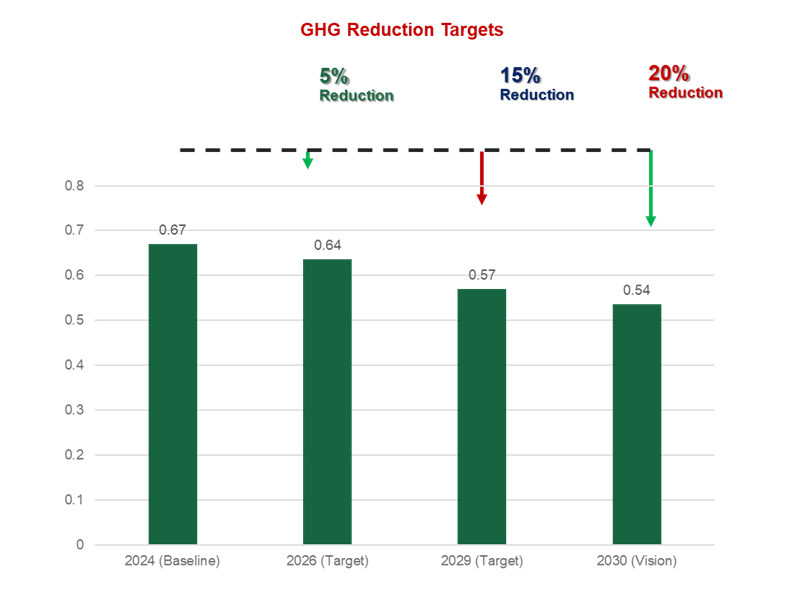
Using 2025 as the base year, VTT has also adopted absolute Scope 1 and 2 emission reduction targets of 5 percent by 2026, 15 percent by 2029 and 20 percent by 2030, anchored in practical measures such as improving office energy efficiency, managing fuel and utilities more carefully and expanding the use of digital, paper light ways of working, as part of our broader commitment to contribute, within our scale, to a more sustainable and climate responsible world.